Turning Consumer Chaos Into Game Tension
Black Friday started with a focused challenge: how do you turn everyday consumer chaos into a tense, replayable game system without relying on puzzles or complex narrative?
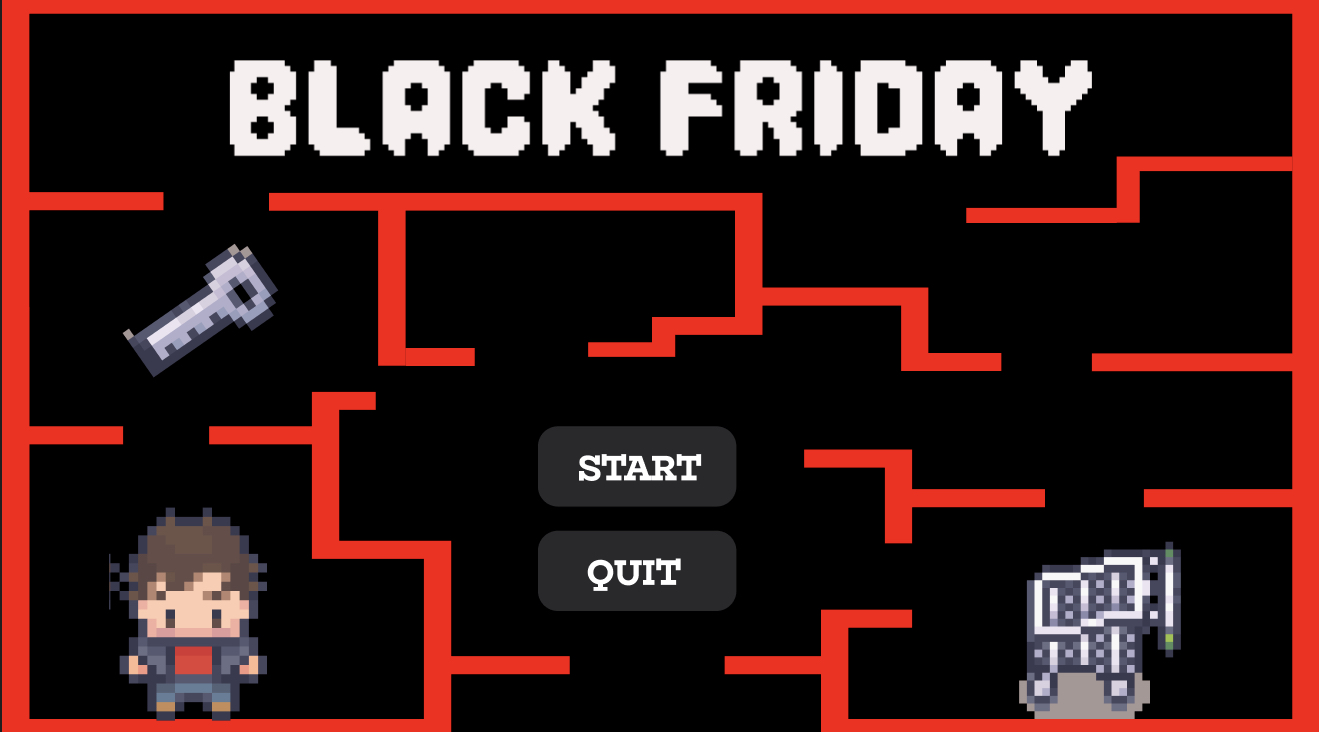
Our goal was to create stress and urgency purely through movement, enemy behavior, and time pressure — making the experience feel overwhelming in a way that mirrors real Black Friday crowds: fast, claustrophobic, and unpredictable.
Who We Designed For
Our target audience is casual and indie players who enjoy exploration, puzzle solving, and stealth mechanics. Fans of top-down adventure and roguelike games will find the gameplay familiar yet fresh. Players who appreciate creative, satirical twists on real-world events — like turning a Black Friday mall into a high-stakes escape — will be especially drawn in.
How We Built It
GDD & Concept
Wrote a Game Design Document establishing core loop: collect items, avoid enemies, escape before time runs out.
Unity Prototype
Built early maze prototype with 8-directional movement and basic enemy patrol to test core tension.
Playtesting
Ran iterative user playtests asking: do players understand detection? Is time limit fair? Does the maze encourage exploration?
MDA Analysis
Applied MDA framework to evaluate player experience and tune systems based on failure points and feedback.
Core Mechanics
8-Dir Movement
Precise 8-directional navigation built for tight maze corridors.
Line of Sight
Enemy detection using line-of-sight to reward careful positioning.
Stealth AI
Patrol routes with predictable behavior — challenging but readable.
Timer System
Constant pressure through a countdown that forces decisive action.
Key Collectables
Randomized key and item spawns increase replayability each run.
Power-Ups
Situational abilities that create risk/reward decisions mid-run.
See Them In Action
Invisibility Power-Up
Temporarily renders the player invisible to enemies, allowing safe passage through heavily patrolled areas.
Speed Boost Power-Up
Doubles movement speed for a short burst — perfect for grabbing a key and escaping before the timer runs out.
What I Built
View the Repository
Black Friday — GitHub Repository
Browse the full Unity project source, including level design, C# scripts for power-ups, collectables, AI patrol, and the complete game build.
What We Overcame
Team Scheduling
With 5 members and different class schedules, coordinating development time was a constant challenge across the semester.
Async Workflow
We maximized in-class work time, used group chats actively, and divided tasks so progress could continue independently.
GitHub Merge Conflicts
Unity's scene-based structure caused significant merge conflicts and occasional corruption when multiple members worked simultaneously.
Sequential Scene Work
Members avoided simultaneous edits, worked on separate scenes, and maintained strict pull/push protocols with frequent backups.
Stealth Balance
Making the detection system feel tense but fair was an ongoing design challenge throughout playtesting rounds.
Visual Feedback System
We implemented a visual indicator system so players can clearly understand their detection risk at all times.
What We Delivered
The project resulted in a complete, fully playable two-level 2D top-down escape game. Reflecting on development, the game grew from a simple early prototype into a polished and engaging experience shaped extensively by iterative testing, continuous refinement, and close team collaboration.
Where It Could Go
Try It Yourself
The game is live and playable — jump in and see how long you can survive.